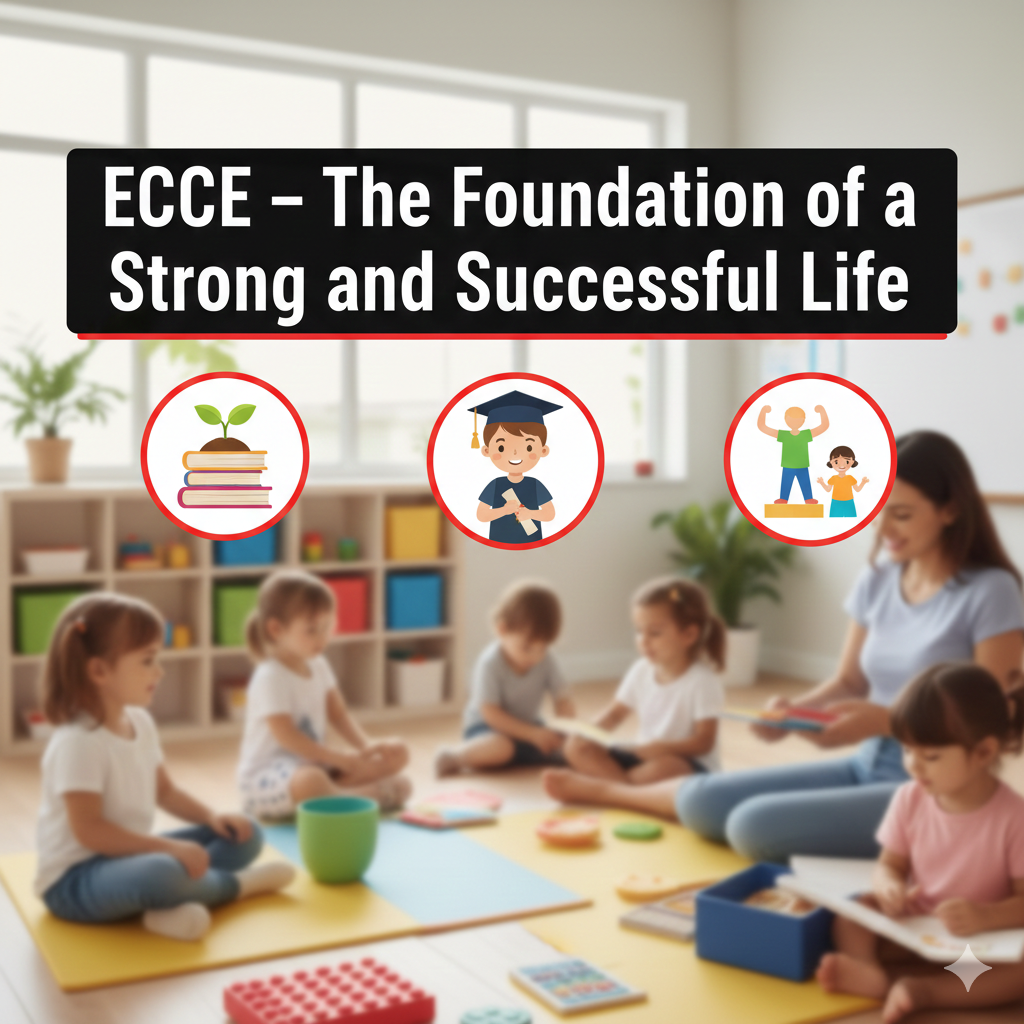
ECCE – The Foundation of a Strong and Successful Life
Introduction
Early Childhood Care and Education (ECCE) is the most important phase of a human being’s life. From birth to eight years of age, a child experiences the fastest brain development, emotional growth, and learning ability. During this period, children develop not only academic skills but also their personality, confidence, behavior, and social understanding.
Yet, ECCE is often misunderstood as simply pre-school or play school. In reality, it is a scientifically designed system that shapes the future of individuals, societies, and nations.
This article explains what ECCE is, why it matters, how it works, and how it aligns with India’s National Education Policy (NEP) 2020 and global education standards.
What is Early Childhood Care and Education (ECCE)?
ECCE stands for Early Childhood Care and Education. It refers to the complete range of support that young children need for healthy growth and learning during the ages of 0 to 8 years.
ECCE includes:
- Physical health and nutrition
- Emotional and social development
- Language and communication
- Cognitive and problem-solving skills
- Creativity and imagination
- Moral and cultural understanding
Unlike traditional schooling, ECCE focuses on the whole child, not just reading and writing.
Children learn best through:
- Play
- Interaction
- Exploration
- Observation
- Real-life experiences
This is why ECCE uses play-based and activity-based learning rather than memorization or exams.
Why ECCE Is the Most Critical Stage of Education
Research shows that nearly 90% of brain development happens before the age of 6. The experiences children have in their early years shape:
- How they think
- How they feel
- How they learn
- How they behave
Children who receive quality early education:
- Perform better in school
- Have stronger communication skills
- Show better emotional control
- Are more confident and creative
- Are less likely to drop out of school
In contrast, children who lack proper early care may face:
- Learning difficulties
- Emotional stress
- Poor social skills
- Long-term academic struggles
This is why ECCE is not optional. It is the foundation of lifelong success.
ECCE in India under NEP 2020
India’s National Education Policy (NEP) 2020 gave ECCE the importance it deserves.
NEP 2020 introduced the Foundational Stage for children aged 3 to 8 years, replacing the old system that ignored early learning.
Under NEP 2020:
- ECCE is recognized as the base of all education
- Learning is play-based, joyful, and activity-driven
- Focus is on language, numbers, and creativity
- No formal exams in early years
- Teachers are specially trained for young children
The aim is to ensure that every child in India enters Grade 1 with strong learning and social skills.
Global Importance of ECCE
International organizations like UNESCO, UNICEF, and WHO strongly support ECCE.
Countries that invest in early childhood education:
- Have lower poverty
- Higher literacy rates
- Better health
- Stronger economies
Studies show that every rupee spent on ECCE returns many times more in future economic growth, reduced crime, and better health outcomes.
That is why ECCE is considered one of the smartest investments a country can make.
Core Areas of ECCE
1. Physical Development
Children need:
- Good nutrition
- Safe environments
- Active play
- Motor skill development
This helps build strong bodies and healthy habits.
2. Emotional and Social Development
Children learn:
- How to express emotions
- How to interact with others
- How to share and cooperate
- How to build relationships
This forms the basis of mental health and confidence.
3. Language and Communication
Early years are critical for:
- Speaking
- Listening
- Vocabulary building
- Storytelling
Strong language skills lead to better learning in all subjects.
4. Cognitive Development
Children develop:
- Memory
- Thinking
- Problem-solving
- Curiosity
Through puzzles, games, exploration, and hands-on activities.
5. Creativity and Imagination
Art, music, movement, and play allow children to:
- Think freely
- Express ideas
- Build innovation
Creativity is essential for future success.
Role of Play in ECCE
Play is not a waste of time. It is the most powerful learning tool for young children.
Through play, children learn:
- Numbers
- Language
- Social rules
- Emotions
- Science and logic
Play-based learning makes education:
- Enjoyable
- Stress-free
- Long-lasting
This is why modern ECCE rejects rote learning and promotes exploration.
Role of Parents and Caregivers
Parents are a child’s first teachers.
Good ECCE at home includes:
- Talking to children
- Reading stories
- Encouraging curiosity
- Providing love and security
- Limiting stress and fear
Home and school together create the best environment for growth.
Importance of Trained ECCE Educators
Teaching young children requires special skills. ECCE educators must understand:
- Child psychology
- Learning styles
- Emotional needs
- Developmental stages
A good ECCE teacher:
- Encourages
- Guides
- Listens
- Supports
- Inspires
They shape not just knowledge, but character.
ECCE and Social Equality
ECCE helps reduce:
- Poverty
- Learning gaps
- Gender inequality
- Social disadvantages
When all children get a strong start, society becomes more fair and balanced.
Challenges in ECCE
Despite its importance, ECCE faces challenges:
- Lack of awareness
- Poor infrastructure
- Untrained staff
- Low investment
This is why information and education about ECCE are essential.
Why Awareness about ECCE Matters
When parents and society understand ECCE:
- Children get better care
- Schools improve quality
- Governments invest more
- Communities become stronger
Awareness leads to action.
Conclusion
Early Childhood Care and Education is not just the first step of schooling—it is the foundation of human life.
Strong ECCE means:
- Strong children
- Strong families
- Strong society
- Strong nation
[…] Read also: ECCE – The Foundation of a Strong and Successful Life […]