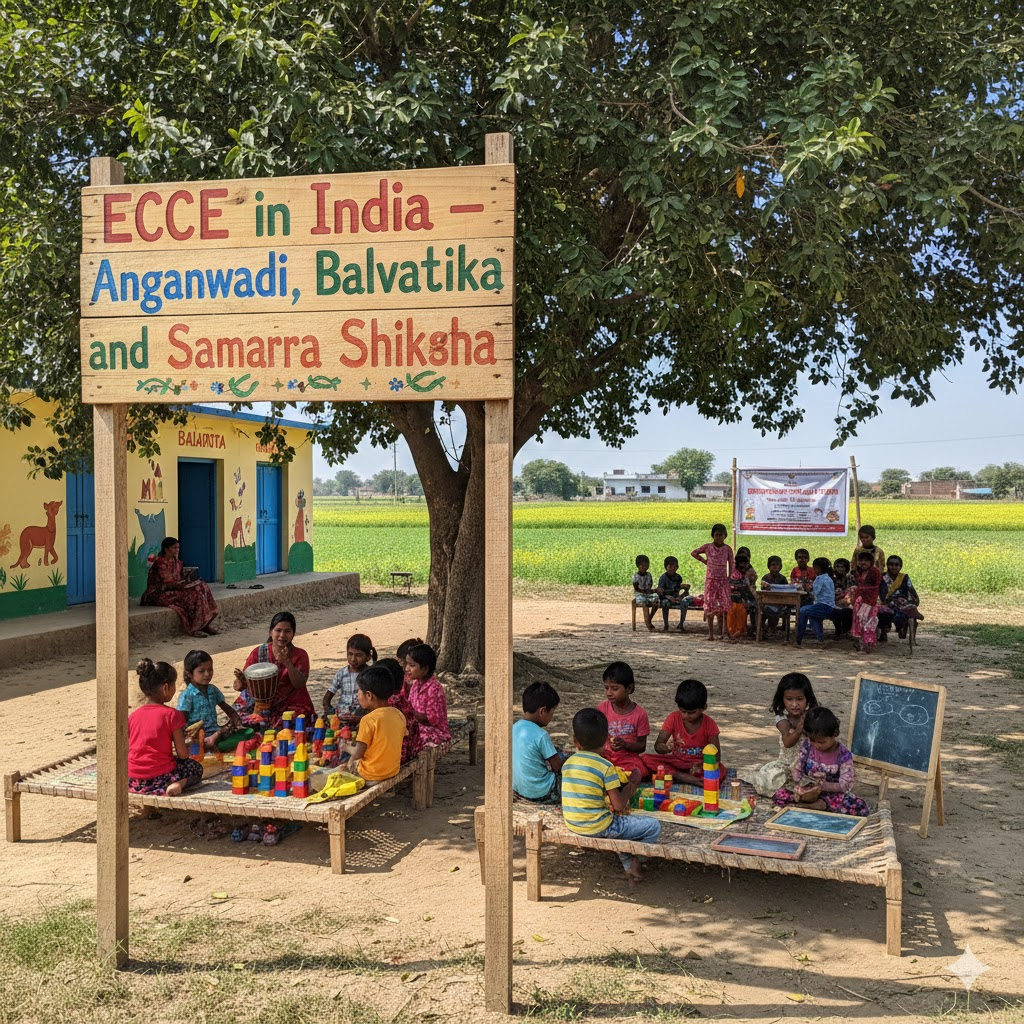
ECCE in India – Anganwadi, Balvatika and Samagra Shiksha
ECCE in India is delivered through Anganwadi centres, Balvatika classrooms and the Samagra Shiksha programme to ensure that children between 3 and 8 years develop strong cognitive, emotional, physical and language foundations before entering Class 1.
Table of Contents
What ECCE in India Means
Early Childhood Care and Education refers to the care, nutrition, emotional support and early learning provided to children from birth to eight years of age. ECCE In India, this system is designed to ensure that children are not pushed into formal academics too early but instead grow through play, interaction and exploration.
The Indian government recognized that children entering Class 1 without strong foundations struggle throughout their school life. To fix this, preschool education was integrated into the formal education system through Anganwadi centres, Balvatika and the Samagra Shiksha programme.
This ensures that children receive:
- Proper nutrition and health care
- Emotional and social development
- Language and early numeracy skills
- A safe and stimulating learning environment
Why Early Childhood Education Matters
The first eight years of life decide how well a child will learn, think and adapt in the future. During this time:
- Brain connections form rapidly
- Emotional patterns are established
- Learning habits are created
Children who receive structured early education:
- Perform better in school
- Drop out less
- Have better health
- Earn more as adults
Countries that invest in early childhood education experience lower crime rates, higher productivity and stronger economies. That is why India has made preschool education a national priority.
Role of Anganwadi Centres
Anganwadi centres are the backbone of India’s preschool system. These centres operate under the Ministry of Women and Child Development and serve millions of children across the country.
Anganwadi centres provide:
- Nutrition and health monitoring
- Early learning through play and activities
- Emotional care and social interaction
- School readiness programs
Under Samagra Shiksha, Anganwadi centres are being upgraded with:
- Child-friendly classrooms
- Educational toys and learning materials
- Trained early childhood educators
- Better infrastructure
Many Anganwadis are now co-located with government schools, allowing children to smoothly transition into formal schooling.
What is Balvatika – ECCE in India
Balvatika is the preparatory class before Class 1. It is designed for children aged 5 to 6 years and acts as a bridge between Anganwadi and primary school.
Balvatika focuses on:
- Play-based learning
- Language development
- Basic numeracy
- Social skills
- Emotional confidence
The goal is not to teach children to memorize books but to help them become curious, confident and ready to learn.
Balvatika classrooms are now being established inside government primary schools so that children feel comfortable in the school environment before entering Grade 1.
How Samagra Shiksha Supports Preschool Education
Samagra Shiksha is India’s flagship education program that integrates preschool, school and teacher training into one unified system.
Under this programme:
- Anganwadi centres receive learning materials and furniture
- Teachers are trained in early childhood pedagogy
- Balvatika classrooms are set up in schools
- Monitoring systems track child development
Samagra Shiksha ensures that preschool education is not isolated but connected to the school system. This prevents learning gaps and ensures continuity.
More information is available on the official portal of the Government of India:
https://samagra.education.gov.in
National Education Policy 2020 and Early Learning
The National Education Policy 2020 declared early childhood education as the foundation of the entire school system for ecce in India. It mandates:
- Universal access to preschool education
- Play-based and activity-based learning
- Trained teachers for early years
- Strong linkages between Anganwadi and schools
The policy also extended health services, mid-day meals and growth monitoring to Balvatika students.
Official policy details are available at:
https://www.education.gov.in
Benefits for Children and Society by Ecce in India
When preschool education is done properly, children:
- Learn faster
- Develop confidence
- Communicate better
- Show better behavior
- Adapt easily to school
Society benefits through:
- Higher literacy
- Better workforce
- Lower healthcare costs
- Reduced inequality
Early childhood education is one of the highest return investments any country can make.
Future of Early Childhood Education in India
India is now building a national network of high-quality preschool institutions through:
- Strengthened Anganwadi centres
- School-based Balvatikas
- Digitally trained teachers
- Standardized curriculum from NCERT
NCERT is responsible for developing the national preschool curriculum and guidelines. More information can be found at:
https://ncert.nic.in
The coming years will see a complete transformation of how young children in India are educated, ensuring that no child enters school unprepared.
Read also: ECCE – The Foundation of a Strong and Successful Life
[…] Read also: ECCE in India – Anganwadi, Balvatika and Samagra Shiksha […]