ECCE Admission 2026 (Early Childhood Care and Education)
INTRODUCTION
Early childhood is defined as the period from birth to eight years of age. Early child development
encompasses physical, socio-emotional, cognitive and motor development between 0-8 years of age.
The early years are critical, because this is the period in life when the brain develops most rapidly and
has a high capacity for change, and the foundation is laid for health and wellbeing throughout life.
Nurturing care is provided in a stable environment, that is sensitive to children’s health and nutritional
needs, with protection from threats, opportunities for early learning, and interactions that are
responsive, emotionally supportive and developmentally stimulating is at the heart of children’s
potential to develop.
Research and experience have repeatedly demonstrated that early childhood development programmes
and opportunities for early learning improve child outcomes during subsequent schooling. Coordination
across preschools and primary schools promotes smooth transitions, enables children to build on their
preschool skills, and facilitates a coordinated, sequential strategy for promoting early learning, which
provides support for children across the life course.
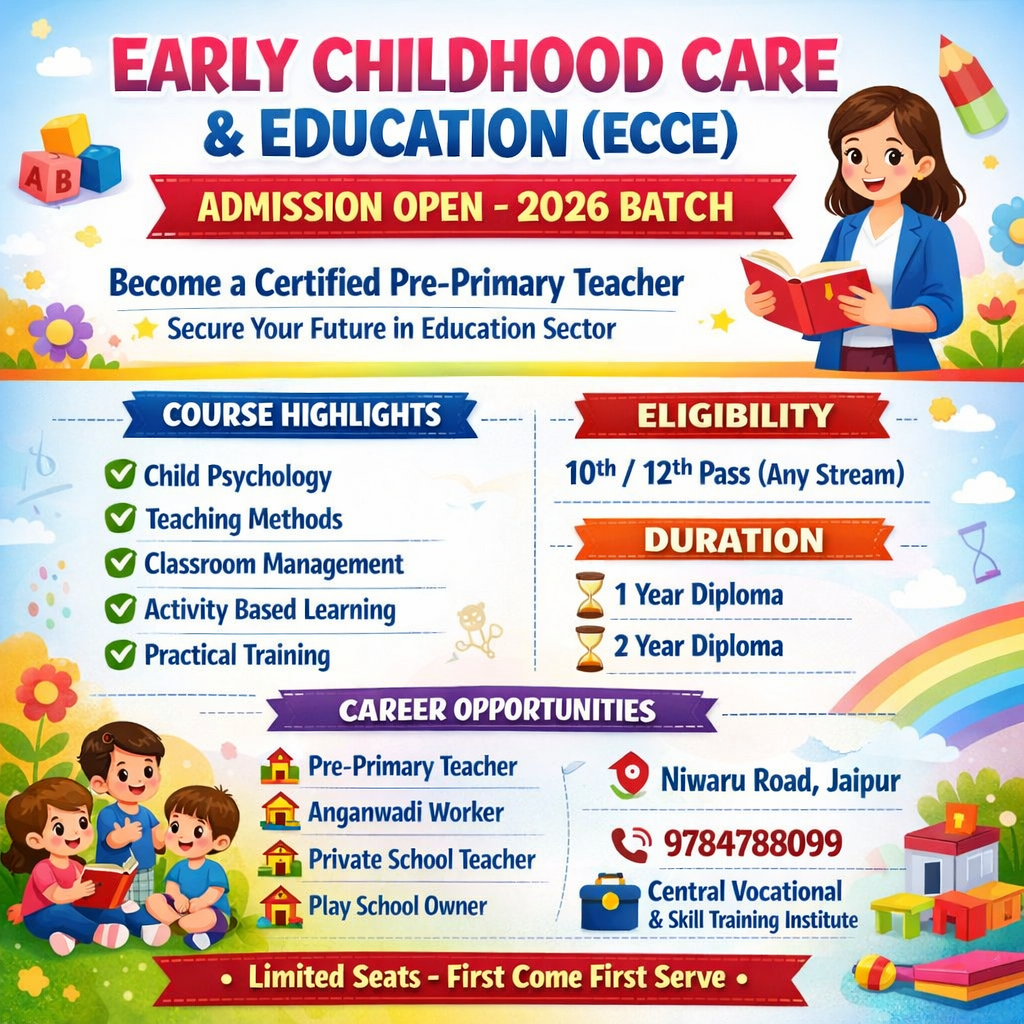
How Can Apply ECCE Course
📌 Course: Early Childhood Care and Education (ECCE)
🔎 Institution: Central Vocational & Skill Training Institute
Rajasthan State Office, Bhagwati Nagar, Nivaru Road, Jaipur – 302012 (Phone: 9784788099)
✅ Qualification (Eligibility): 12th Pass (any stream)
📅 Duration: 1 Year (12 Months)
📍 Admission Session: 2026
💻 Apply Online: You can register online through their official form/registration page at www.csvtindia.org (use “NEW REGISTRATION” to apply)
💰 Fees (approx):
- Application Fee: About ₹1,450* ( late fee +500)
- Course Fee: About ₹10,850* (includes books, online classes, exam fees, ID card etc.)
(*Fees may vary slightly based on session and registration time)
📄 Documents Required (Typical):
- 12th Marksheet
- 10th Marksheet
- Aadhaar Card
- Bank Passbook
- Photograph & Signature
- Mobile Number & Email
📌 How to Apply Online:
- Go to www.csvtindia.org
- Click on Online Registration / New Registration
- Fill in your details (name, mobile, email, qualification)
- Upload required documents
- Pay application & course fee online to complete registration
RECOMMENDATIONS RELATED TO ECCE IN NATIONAL EDUCATION POLICY,2020
Universal Provisioning
1.1 Universal provisioning of quality early childhood development, care, and education must be
achieved as soon as possible, and no later than 2030, to ensure that all students entering Grade 1
are school ready.
Holistic development of children
1.2 The overall aim of ECCE will be to attain optimal outcomes in the domains of physical and motor
development, cognitive development, socio-emotional-ethical development, cultural/artistic
development, and the development of communication and early language, literacy, and numeracy
through flexible, multi-faceted, multi-level, play-based, activity-based, and inquiry-based learning.It
also includes a focus on developing social capacities, sensitivity, good behaviour, courtesy, ethics,
personal and public cleanliness, teamwork, and cooperation.
Curricular and Pedagogical Framework for ECCE
1.3 A National Curricular and Pedagogical Framework for ECCEfor children up to the age of 8 will be
developed by NCERT in two parts, namely, asub-framework for 0-3 year-olds, and a sub-framework
for 3-8 year-olds, aligned with the aboveguidelines, the latest research on ECCE, and national and
international best practices.
Expansion and strengthening of ECCE facilities
1.4 a. Universal access to high-quality ECCE in the country, with a special focus on districts and locations
that are particularly socio-economically disadvantaged, will be provided in a phased manner.
1.4 b. ECCE shall be delivered through a significantly expanded and strengthened system of earlychildhood education institutions consisting of (a) stand-alone Anganwadis; (b) Anganwadis co-located
with primary schools; (c) pre-primary schools/sections covering at least age 5 to 6 years co-located with
existing primary schools; and (d) stand-alone pre-schools – all of which would recruit workers/teachers
specially trained in the curriculum and pedagogy of ECCE
Before the age of 5, every child will move to a “Preparatory Class” or “Balavatika” (that is, before Class
1), which has an ECCE-qualified teacher. The learning in the Preparatory Class shall be based primarily
on play-based learning with a focus on developing cognitive, affective, and psychomotor abilities and
early literacy and numeracy.
1.5. The mid-day meal programme shall also be extended to the Preparatory Classes in primary
schools. Health check-ups and growth monitoring that are available in the Anganwadi system shall also
be made available to Preparatory Class students of Anganwadi as well as of primary schools.
Professionalisation of High-Quality Educators
1.7.a. Anganwadi workers/teachers with qualifications of 10+2 and above shall be given a 6-month
certificate programme in ECCE; and those with lower educational qualifications shall be given a one-year
diploma programme covering early literacy, numeracy, and other relevant aspects of ECCE.
1.7.b. These programmes may run through digital/distance mode using DTH channels as well as
smartphones, allowing teachers to acquire ECCE qualifications with minimal disruption to their current
work.
1.7.c. The ECCE training of Anganwadi workers/teachers will be mentored by the Cluster Resource
Centres of the School Education Department which shall hold at least one monthly contact class for
continuous assessment.
1.7.d. In the longer term, State Governments shall prepare cadres of professionally qualified educators
for early childhood care and education, through stage-specific professional training, mentoring
mechanisms, and career mapping. Necessary facilities will also be created for the initial professional
preparation of these educators and their Continuous Professional Development (CPD).
1.8. ECCE will also be introduced in Ashramshalas in tribal-dominated areas and in all formats of
alternative schooling in a phased manner.
Planning and Implementation of ECCE
1.9.a. The responsibility for ECCE curriculum and pedagogy will lie with MHRD to ensure its continuity
from pre-primary school through primary school, and to ensure due attention to the foundational
aspects of education.
1.9.b. The planning and implementation of early childhood care and education curriculum will be carried
out jointly by the Ministries of HRD, Women and Child Development (WCD), Health and Family Welfare
(HFW), and Tribal Affairs.
1.9.c. A special joint task force will be constituted for continuous guidance of the smooth integration of
early childhood care and education into school education.
Planning and Implementation of ECCE
1.9.a. The responsibility for ECCE curriculum and pedagogy will lie with MHRD to ensure its continuity
from pre-primary school through primary school, and to ensure due attention to the foundational
aspects of education.
1.9.b. The planning and implementation of early childhood care and education curriculum will be carried
out jointly by the Ministries of HRD, Women and Child Development (WCD), Health and Family Welfare
(HFW), and Tribal Affairs.
1.9.c. A special joint task force will be constituted for continuous guidance of the smooth integration of
early childhood care and education into school education.